Why a Folded Strip Resists Bending
Why a folded strip resists bending: compare flat, folded and curved paper to choose a simple shape for a model, bookmark or lightweight support.
The common mistake with a paper strip is to add layers when a change of shape would do. A folded strip resists bending because its paper sits farther from the fold’s centre line, so the strip can feel stiffer without becoming a thick stack. A simple comparison of flat, folded and curved strips shows which shape suits a light, low-stakes project.
What changes when paper is folded?
A flat strip bends readily because its broad face can curve along its length. Folding turns part of that face upright. The paper now forms a ridge or wall, and that altered cross-section resists a bend in one direction.
Think of the fold as a small beam rather than a crease that magically strengthens every part of the sheet. A ridge, channel or shallow V can resist sagging along the strip, but the same strip may still twist or buckle sideways. Its direction and shape matter as much as the fact that it is folded.
The change is easiest to notice when you hold the strip by its ends and let the middle hang. A flat strip tends to curve down; a strip with an upright ridge may hold its line more readily. This is a qualitative comparison, not a claim that the folded version is suitable for carrying a load.
How do flat, folded and curved strips compare?
A flat strip is the simplest option. It is quick to cut, easy to mark and useful when the paper needs to lie against a surface, bend freely or fit under a cover. It suits a label, paper tab or flexible hinge better than a part expected to stay straight while spanning a gap.
A single ridge fold is a useful middle choice. Fold a strip lengthways to make a shallow V, or fold narrow edges upwards to form a channel. Either shape can resist bending along its length while remaining light and easy to alter; the V is quick to make, while the channel has two upright sides and may feel less inclined to roll sideways.
A curved or rolled strip offers a different balance. A gentle arch can resist downward sag while leaving the underside open, and a loose tube resists bending in more than one direction better than a flat strip. Curves are less convenient where a straight edge or flat contact surface is needed, and a loose roll can unwind unless its ends are held.
Choose flat paper for flexibility and close contact, a ridge or channel for a straight span, and an arch or tube when the part must also resist twisting. These are starting points: the actual paper, fold depth, span and direction of handling all affect the result.
How can you compare the shapes fairly?
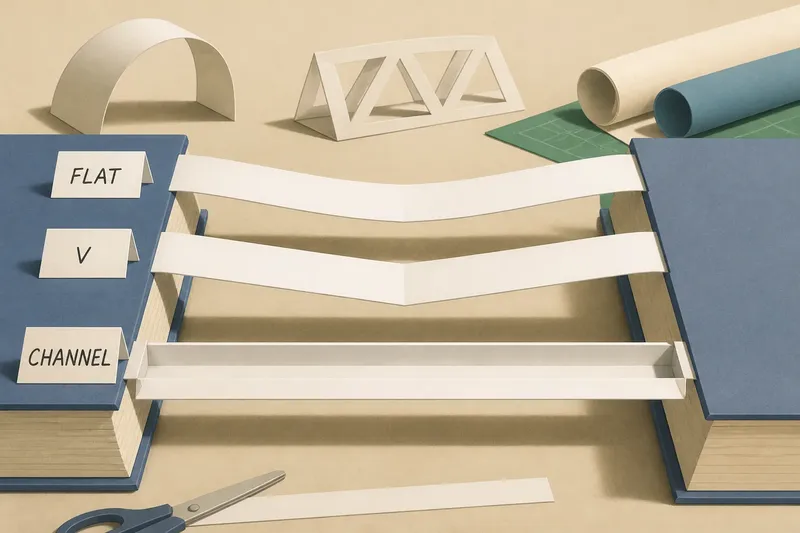
Use three strips cut from the same sheet, with the same width and length. Leave one flat, fold another into a lengthways V, and curve the third into a loose arch. Keep the paper grain and any printed or coated face consistent where possible; mixed material makes the comparison harder to interpret.
Rest each strip across the same two book edges, with the same amount of paper extending beyond each edge. Look at the centre from the side, then gently tap the table or touch the strip in the same way each time. You are comparing visible sag and the ease with which each shape changes, not testing how much weight it can safely hold.
Say you are making a paper sign that must stand across a narrow gap. If the flat strip bows, imagine replacing it with a shallow V fold while keeping the span and paper unchanged; the expected observable result is a smaller visible dip in the middle. If it instead rolls sideways, a channel may be a better next shape to compare.
Change one feature at a time. If you make the folded strip shorter as well as deeper, you cannot tell whether the change in stiffness came from the fold or the shorter span. A scrap of paper beside each strip, marked “flat”, “V” and “channel”, helps keep the comparison clear.
Which fold should you choose for the job?
For a bookmark or a tag that should remain flexible, keep the paper flat. A fold can make it spring away from the page or create a ridge that catches, so extra stiffness may work against the purpose.
For a lightweight rail, sign edge or paper bridge used only as a model, try a V or channel. Choose the V when you want a quick, narrow ridge; choose the channel when a broader base can sit flat and two raised sides may help resist a sideways roll.
For an arch, canopy or curved trim, start with a gentle curve rather than forcing a sharp crease. The curve can keep the paper from sagging in its intended direction, but it may flatten when pressed from above. A curved form suits a display shape better than a part that must remain flat against another piece.
Fold depth is a useful adjustment. A deeper ridge generally moves more paper away from the flat plane, but it also changes the strip’s profile and how it connects to neighbouring parts. Make the smallest fold that gives the shape you need, then check that the edges still meet the rest of the model.
Why does the same fold sometimes feel weaker?
Paper can crease sharply, tear at a cut edge or soften where it has been handled. A tight crease may hold a neat profile, while a rounded fold may open more easily; neither is automatically best, since the surrounding shape determines how the strip behaves.
Width and span also matter. A long, narrow strip may sag even with a ridge, while a shorter strip of the same paper can appear firm. When comparing shapes, keep those dimensions fixed; when adapting a finished model, adjust the fold or support points to suit the actual gap.
The orientation of the fold is another common source of surprise. A lengthways ridge helps with bending along the strip, but turning the strip so the force acts across the ridge can produce a different response. Try the direction in which the object will actually be handled.
What do people ask about folded paper stiffness?
Does folding paper always make it stiffer?
No. A fold changes the strip’s shape and usually helps resist bending in a particular direction, but it can also create a hinge that bends readily at the crease. The fold’s orientation and the force applied determine what you notice.
Is a V fold or a channel fold better?
A V fold is quick and suits a narrow ridge, while a channel gives the strip a broader base with two raised sides. Compare them at the same length and width, then choose the shape that sits neatly in the model and resists the kind of movement you want to limit.
Will thicker paper always make a better support?
Thicker paper may feel firmer, but a folded profile can sometimes provide the useful stiffness with less bulk. If the part must fit into a slot or lie against a surface, check those constraints before choosing a heavier sheet.
Can a paper fold support a real object?
Treat an improvised paper fold as a model feature or light prop, not as a support for something valuable or hazardous. Paper can crease, tear or change shape without warning, so use a purpose-made support where a failure could cause harm.
How should you choose your final shape?
Start with the movement you want to prevent: sagging along the length, rolling sideways, or unwanted bending at a particular point. Then choose the least complicated shape that addresses that movement. A flat strip remains best when flexibility matters; a ridge or channel suits a straight, light span; a curve or tube makes sense when a rounded profile is part of the design.
Make a small folded-strip comparison from matching scraps before committing to the finished piece. That quick check reveals whether the fold helps in the direction you need, while leaving the paper easy to reshape if it does not.