Before the Pop-Up Book: Paper Engineering on the Page
Paper engineering on the page turns diagrams, flaps and layered images into hands-on reading, revealing how a page can organise information or stage a scene.
The common mistake is to call every book with a moving part a pop-up book. That blurs an important distinction: paper engineering on the page includes devices that organise or reveal information, as well as constructions that rise into a scene. A rotating diagram, for instance, can be useful without looking like a miniature theatre.
What does paper engineering on the page mean?
Paper engineering is the design of paper parts that make a printed page do more than present a fixed image. A flap can conceal one picture and uncover another; a rotating disc can align labels with a window; a folded section can open into a shallow scene. The reader’s action is part of how the page works.
“Movable book” is a broad term for a book with parts intended to be handled. “Pop-up book” is narrower in ordinary use: it usually describes a structure that rises or expands when a spread opens. The terms overlap, but not every movable feature pops up.
A hinged flap may serve as an instructional device rather than a miniature theatre. Conversely, a flat illustration can suggest a stage through layers, concealment and a carefully controlled view.
How were movable pages used as tools for thought?
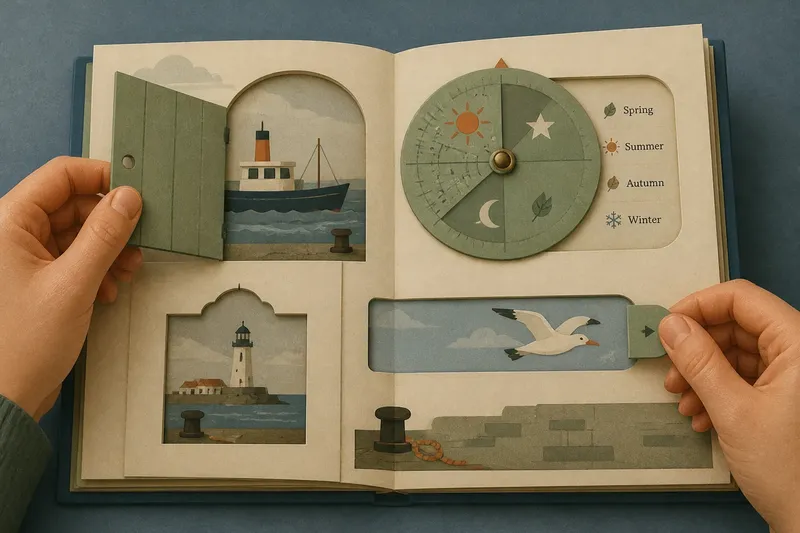
Movable paper has appeared in books as a way to compare, arrange or interpret information. One familiar form is the volvelle: a rotating paper disc set against a printed base, with markings that can be brought into alignment. The reader turns the disc and inspects the resulting relationship rather than simply looking at a fixed diagram.
Such mechanisms can make a changing relationship easier to follow. A wheel may bring selected labels together, while one paper layer can hide details until they are needed. The sequence of actions—turn, align, inspect—becomes part of reading.
Movable pages have served different purposes and used different constructions; they should not be treated as a single, steadily developing procession of elaborate novelties. Some were integrated into works concerned with explanation or interpretation, rather than being designed chiefly for amusement. The mechanism’s purpose depends on the page around it.
When does a page begin to behave like a stage?
A page suggests theatre when it controls a view, conceals something and gives the reader a moment of reveal. A flap can show a before-and-after contrast; a cut-out can frame a detail underneath; a slider can shift a figure against a fixed setting. None needs to rise high to make the page feel performative.
Imagine a paper harbour scene whose starting view shows a quiet quay, a closed paper door and a gull printed on a sliding strip. The reader lifts the door to reveal a boat underneath, then pulls the strip to move the gull across the sky. The expected result is a sequence of visible changes: the boat appears, and the gull shifts position. The reader’s actions set the timing, so the page works like a small stage.
Movement feels purposeful when it changes what the reader can see or understand. If a part moves without affecting the image or idea, it may seem detached from the page.
Which mechanisms create different kinds of movement?
Each mechanism offers a distinct relationship between the paper and the reader’s hand:
- Flaps: Hinged pieces cover and uncover printed details. They suit hidden information, contrasts and layered explanations.
- Sliders: A strip moves through a track or slot. It can shift a figure, change a label in a window or replace one image with another.
- Rotating discs: A circle turns around a paper pivot or fastener. Markings can be aligned, or a window can reveal different selections.
- Cut-out windows: An opening in one sheet shows part of an image beneath it. This creates a framed view without a hinged or sliding part.
- Folded structures: Creases make a section expand as a page opens. This is the construction most often associated with a conventional pop-up.
Choose a mechanism for the change it makes visible: use a flap for concealment, a slider for motion, or a wheel for selection and alignment.
How does the mechanism shape what a reader understands?
Handling directs attention. Lifting a flap invites comparison between its surface and what lies beneath; turning a disc encourages the reader to look for alignment. The action separates one stage of looking from the next.
A movable layer can also reveal one relationship at a time, rather than crowding every detail into a fixed diagram. That can make a sequence or contrast easier to follow, provided the movement connects clearly to the surrounding words and images.
Not every mechanism improves understanding. If readers cannot tell what a part does, or why its movement matters, the action can distract. A clear cue—such as a visible tab, a marked window or an illustration that continues across layers—helps connect the gesture to the result.
Which questions help identify a movable page?
Is every movable book a pop-up book?
No. A movable book can use flaps, rotating wheels or sliders that stay flat against the page. “Pop-up” usually describes a structure that rises or expands as the book opens.
What is a volvelle?
A volvelle is a rotating paper wheel or disc attached to a page. Its markings or windows can help readers align or compare information without building a three-dimensional scene.
Why do some movable pages use cut-out windows?
A cut-out shows a selected part of the sheet beneath it, controlling what the reader sees. It can create a layered view and direct attention without a hinged or sliding piece.
What makes a paper mechanism feel theatrical?
Concealment, viewpoint and timing create a theatrical effect, not height alone. A flap, slit or slider can stage a reveal when the reader’s action determines what appears.
What should you inspect on a movable page?
To read a paper mechanism closely, check the visible action and decide what it contributes. If the result is unclear, compare the page before and after moving the part, or examine how its layers are arranged.
- Check the moving part: If it lifts, turns or slides freely and predictably, identify what it changes; if it catches or has no clear purpose, inspect the hinge, pivot or track before interpreting the effect.
- Check what is hidden: If lifting a flap reveals a related image or label, read the two views as a contrast; if the revealed detail does not connect, look for a caption or another visual cue.
- Check the direction of travel: If a slider follows a visible track, follow its path and note what changes; if the path is unclear, use the printed marks or window to determine the intended direction.
- Check a rotating disc’s alignment: If markings line up with a window or base label, compare those selections; if they do not align, turn the wheel to another marked position rather than assuming a match.
- Check the layers beneath a cut-out: If the opening frames a meaningful detail, treat it as a selected view; if it shows an incomplete fragment, inspect the surrounding sheet or reposition the page before drawing a conclusion.
- Check what happens as the book opens: If a folded structure expands with the spread, it fits the usual meaning of a pop-up; if the parts remain flat, describe it more specifically as a flap, slider, wheel or layered page.
Say you are examining an invented page with a circular wheel, a window marked “season” and four printed labels beneath it. First, you note the starting position: the window shows “spring”. Next, you turn the wheel until the window shows “autumn” and compare the label with the fixed illustration beside it. If the illustration changes in a way that matches the selected label, the wheel is organising a comparison; if nothing else on the page relates to that selection, the wheel may be offering a choice without explaining its significance. That distinction tells you what the mechanism contributes, not merely what it does.
Why does the reader’s hand belong in the story?
Movable paper sits between print and object. It uses familiar book features—pages, captions and illustrations—but also asks the reader to touch, turn or lift. Meaning can arrive through a sequence of gestures as well as through sentences.
A hidden image appearing at the right moment can make discovery part of reading; a wheel aligning two markings can make comparison active. The most useful question is not only whether a page pops up, but what the hand is asked to do and what that action reveals. Paper engineering on the page becomes easier to understand when the movement is read as part of the explanation.